



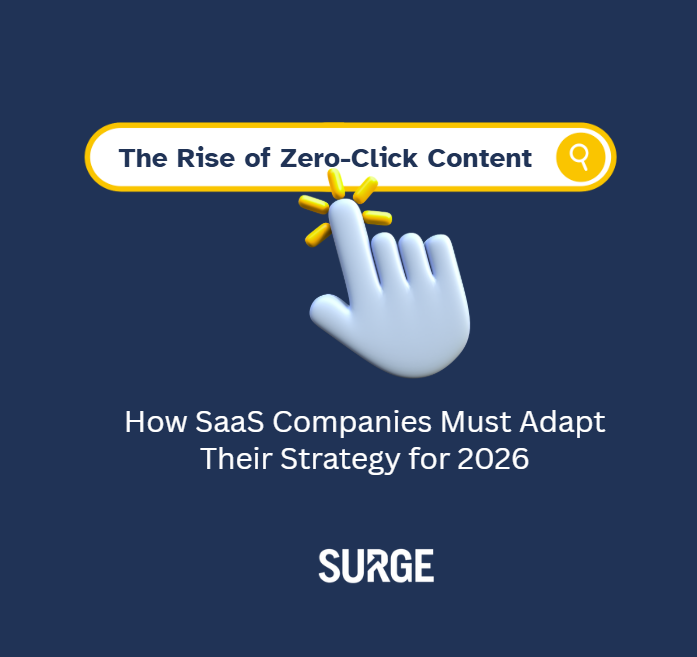
Most SaaS marketing teams still measure success by clicks and traffic. That model is breaking. In 2026, the majority of search queries are answered directly inside the search interface. Google AI Overviews, ChatGPT, and Perplexity now deliver full responses without sending users to your website.
According to Semrush research, 58.5% of US searches and 59.7% of EU searches now end without a single click. That number climbs to over 80% on queries that trigger AI Overviews.
This is not a future prediction. This is the current state of search. If your SaaS company relies on informational blog traffic to fill the funnel, you need a new approach. We wrote this guide to help SaaS leaders understand zero-click search and build a strategy that works in 2026 and beyond.
What Is Zero-Click Content?
Zero-click content is any search result that answers a user’s question directly inside the search interface, without requiring a visit to an external website. The search results page is no longer a gateway. The search results page is the destination.
Common examples of zero-click search formats include:
- Google AI Overviews that summarise answers from multiple sources
- Featured snippets pulled from top-ranking pages
- ChatGPT and Perplexity answers with source citations
- Knowledge panels and People Also Ask boxes
- Direct answer boxes for definitions, calculations, and conversions
Zero-click search occurs when users get their answer directly in the search interface without visiting a website.
Why Zero-Click Search Is Accelerating in 2026
Three forces are pushing zero-click rates higher than ever. Understanding each one is essential for SaaS teams planning their content and B2B SaaS SEO strategy for the year ahead.
How are AI Overviews changing search results?
Google’s AI Overviews now appear on over 13% of all US desktop queries, according to Semrush data from 2025. That figure doubled in under two months. When AI Overviews trigger, the zero-click rate jumps to around 83%. These summaries pull from multiple sources, compile the answer, and present everything users need on the results page.
Why are users asking longer, question-based queries?
Conversational search behaviour is growing fast. Users now type full questions instead of short keywords. Research from BrightEdge confirms that queries of eight or more words trigger AI Overviews far more often than shorter searches. This shift favours long-tail, question-based content, exactly the kind of content SaaS brands should be creating.
Why is organic click-through rate declining for informational queries?
Your impressions are rising. Your clicks are falling. According to Search Engine Land, organic click-through rates in the US dropped from 44.2% to 40.3% year over year. In the EU and UK, the decline went from 47.1% to 43.5%. For SaaS companies targeting informational keywords, this gap will only widen.
Traditional SEO vs Zero-Click Era
|
Metric |
Traditional SEO |
Zero-Click Era (2026) |
|
Success Metric |
Clicks |
Citations and Visibility |
|
Optimisation Focus |
Rankings |
Structured Authority |
|
Content Type |
Keyword-targeted blogs |
Answer-optimised frameworks |
|
Goal |
Traffic |
Influence and Trust |
How Zero-Click Impacts SaaS Marketing
Zero-click is not a general SEO problem. For SaaS companies, the effects are specific and measurable.
What happens to top-of-funnel traffic for SaaS brands?
Educational blog posts that once drove thousands of monthly visits are losing clicks. The content still appears in search. AI pulls from your pages. But users get answers without visiting your site. Gartner predicts traditional search volume will drop 25% by 2026 due to AI chatbots and virtual agents.
Why is brand authority becoming the new KPI?
AI models cite trusted sources repeatedly. If your brand is recognised as an authority in a SaaS category, you get cited across Google AI Overviews, ChatGPT, and Perplexity. That citation is the new equivalent of a first-page ranking. Brands that build trust signals through consistent publishing, expert authorship, and data-backed content will dominate AI-era visibility.
Why do SaaS product pages need to educate, not sell?
Zero-click shifts content depth expectations. Product pages filled only with pricing tables and feature lists get ignored by AI engines. Pages that explain use cases, compare approaches, and answer buyer questions earn citations and trust.
Why does category ownership matter more than keyword ownership?
Winning broad SaaS categories matters more than ranking for single keywords. Instead of ranking for “best CRM tools,” a SaaS brand should own frameworks like “How to evaluate CRM platforms for B2B SaaS.” Category ownership means your brand becomes the go-to source AI models reference when users ask about an entire topic area.
The 2026 SaaS Strategy Shift
Adapting to zero-click requires a structured approach. At Search Digital, we developed a framework specifically for SaaS companies making this shift.
The Search Digital Zero-Click Authority Framework™
1. How do you build definition-level content?
Write clear, standalone explanations for every core term in your SaaS category. Create FAQ-rich pages with 40 to 60 word answers that AI engines extract easily. Every definition should work as a self-contained answer. Think of each explanation as a building block AI models pull from when responding to user queries.
2. How do you structure content for extractability?
Format your content so AI engines prefer your pages as citation sources. This means using:
- Bullet lists for key takeaways
- Tables for comparisons and data
- 40 to 60 word summary paragraphs at the top of each section
- Clean H2 and H3 formatting that mirrors how users phrase questions
3. What comparison and evaluation assets should SaaS brands create?
Build “X vs Y” guides, pricing breakdowns, and use-case matrices. These formats are among the most cited by AI engines because they directly answer purchase-intent queries. A strong B2B SaaS content marketing strategy should include comparison content as a core pillar.
4. How do you develop data-backed authority?
Cite reputable sources in your content. Include original SaaS insights, proprietary data, and expert commentary. AI models favour content that references credible third-party data and adds unique analysis. Generic content without sources gets skipped.
5. How do you optimise for multi-platform AI visibility?
Your content needs to perform across multiple AI platforms, not Google alone. Optimise for:
- Google AI Overviews, which favour structured, well-sourced content
- ChatGPT-style conversational queries that pull from authoritative pages
- Perplexity citation patterns that prioritise recent, expert-driven content
Content Types SaaS Brands Should Prioritise in 2026
Not all content formats hold equal value in a zero-click world. Focus your resources on formats that earn citations and drive downstream conversions.
|
Content Type |
Citation Potential |
Conversion Impact |
|
Definitions and Glossaries |
High |
Low |
|
Framework Guides |
Very High |
Medium |
|
Comparison Pages |
High |
High |
|
Case Studies |
Medium |
High |
|
Opinion Blogs |
Low |
Low |
|
Data Studies |
Very High |
Medium |
|
FAQ Clusters |
High |
Medium |
Pillar strategy pages, framework-based guides, and comparison content should form the core of your 2026 content plan. Industry glossary hubs and FAQ clusters round out the approach by capturing high-volume informational queries where citation potential is strongest.
Metrics That Matter in a Zero-Click World
If your dashboard still leads with organic sessions, you are measuring the wrong things. The new KPIs for SaaS visibility in 2026 include:
- Branded search growth, tracking how often users search your brand name directly
- AI citation frequency, measuring how often your content is referenced in AI-generated answers
- Impression share across search features including AI Overviews and People Also Ask
- Assisted conversions, tracking how content touchpoints contribute to pipeline even without a direct click
- Content engagement depth, measuring scroll rate, time on page, and interaction signals
Declining CTR does not mean declining influence. If your branded search volume is climbing and your content appears in AI answers, your SaaS marketing metrics are telling a growth story, not a decline story.
Common Mistakes SaaS Brands Will Make in 2026
Avoid these traps as you shift your strategy:
- Chasing outdated keyword volume. High volume informational keywords now have low click-through rates. Focus on commercial and brand-building terms instead.
- Publishing thin AI-written content. Surface-level content is the most vulnerable to zero-click loss. AI engines skip generic pages and favour original insight.
- Ignoring schema markup. Structured data helps AI engines parse your content. Without schema, your pages are harder to extract and less likely to be cited.
- Not building brand signals. Brand search is the safest traffic channel in 2026. If users do not know your name, AI will not cite your content.
- Treating AI visibility as another SEO tactic. This requires a full strategy shift. Your content architecture, publishing cadence, and measurement framework all need to adapt.
Why Search Digital Is Leading the Zero-Click Shift for SaaS
Search Digital specialises in AI-era SEO for SaaS companies. We work exclusively with B2B software brands to build SaaS marketing strategies designed for citation-first visibility.
Our proprietary frameworks, including the Zero-Click Authority Framework, are built on real data from SaaS campaigns across Ireland, the UK, and international markets. We do not guess at what works. We measure AI citation frequency, branded search growth, and content engagement depth for every client.
Search Digital is a performance-driven SaaS marketing agency specialising in AI-era SEO, authority content architecture, and scalable growth systems.
Ready to adapt your SaaS strategy for zero-click search? Book a Zero-Click Visibility Audit with Search Digital.
Frequently Asked Questions
What is zero-click search in SEO?
Zero-click search happens when a user gets their answer directly on the search results page without clicking through to any website. This includes answers from AI Overviews, featured snippets, knowledge panels, and People Also Ask boxes.
Will zero-click searches eliminate organic traffic?
No. Organic traffic will decline for informational queries, but commercial and transactional searches still drive clicks. The shift means SaaS brands need to optimise for citations and brand visibility alongside traditional traffic metrics.
How do SaaS companies measure AI visibility?
Track branded search growth, AI citation frequency using tools like Semrush or Similarweb, impression share across SERP features, and assisted conversions. These metrics replace click-only measurement in a zero-click environment.
Does schema markup help with AI citations?
Yes. Schema markup, especially FAQ schema and HowTo markup, helps AI engines understand and extract your content. Structured data increases the chances of your pages being cited in AI Overviews and other zero-click features.
Is traditional SEO dead in 2026?
Traditional SEO is not dead, but traffic-only SEO is losing relevance. The fundamentals of quality content, technical performance, and authority still matter. What changes is how success is measured and how content is structured for AI extractability.
What content formats work best for zero-click SEO?
Framework guides, comparison pages, FAQ clusters, and data studies have the highest citation potential. Structure content with clear headings, bullet lists, tables, and concise 40 to 60 word summary paragraphs for each section.
How does Search Digital help SaaS brands with zero-click strategy?
Search Digital builds citation-focused content architectures for SaaS companies. We use proprietary frameworks to optimise for AI Overviews, ChatGPT, and Perplexity visibility. Our approach covers structured authority content, schema implementation, and multi-platform AI optimisation.