






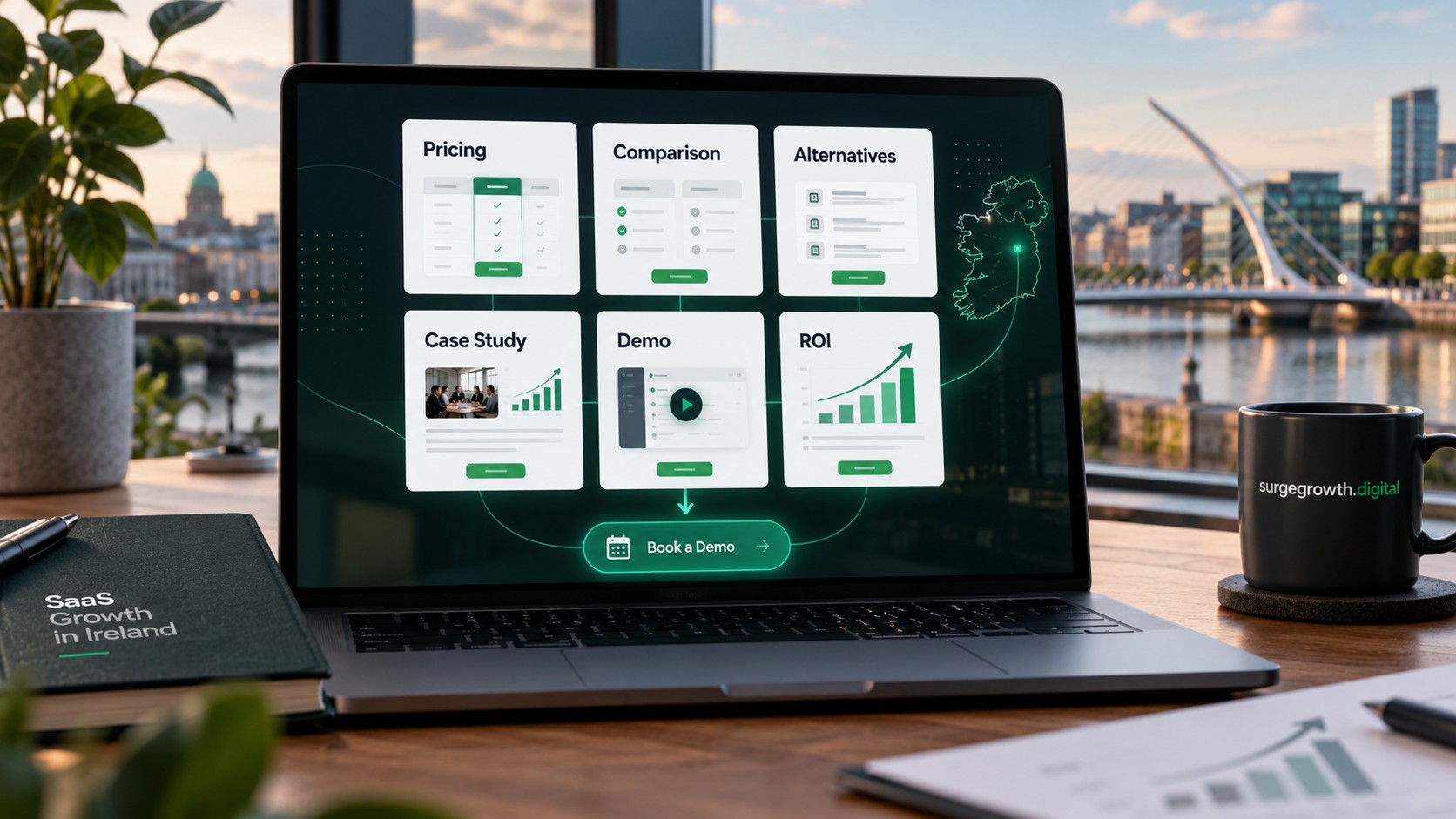
TL;DR
- Bottom of funnel content is the set of pages a buyer reads just before booking a demo.
- For SaaS companies selling in Ireland, six page types matter most: comparison, alternatives, pricing, integration, use case pages, and case studies.
- Irish search volumes are small, so these pages earn their place through demo requests, sales conversations, and AI citations rather than traffic.
- Irish details make the difference: euro pricing with VAT stated, EU data hosting, local integrations, and named Irish customers.
- Fix your pricing page first, then build alternatives pages for the competitors your buyers leave most often.
Bottom of funnel content is the set of pages a buyer reads just before they book a demo. For SaaS companies selling in Ireland, these are the six that matter most:
- Comparison pages
- Alternatives pages
- Pricing pages
- Integration pages
- Use case pages
- Case studies
Irish SaaS search volumes are small, so these pages earn their place through demo requests and AI citations more than traffic. When a buyer asks ChatGPT or Google AI Overviews to compare tools, the answer often quotes exactly these page types.
1. Comparison pages
A comparison page puts your product side by side with one named competitor, usually titled “[You] vs [Competitor]”. It helps a buyer who has narrowed the shortlist to two options make the final call. For an Irish buyer, the comparison should cover euro pricing and EU data hosting.
Search demand for these pages is often low in Ireland, so their main value is elsewhere. Sales teams send them to prospects mid-deal, and AI tools quote them when a buyer asks ChatGPT to compare two products directly. A fair, factual page with a clear table is far more likely to be quoted than a one-sided pitch.
Checklist
- A comparison table near the top with pricing in euro for both products
- An honest note on where the competitor is the better fit
- EU data hosting and GDPR position for both products
- Irish support hours and any Irish customers you can name
2. Alternatives pages
An alternatives page lists several options for buyers leaving a named competitor, usually titled “Best [Competitor] alternatives”. It catches buyers who already know the category and are unhappy with their current tool. Your product sits in the list with the others, so the page reads as a guide.
In our work with one SaaS client, keyword research showed “[brand] vs [competitor]” searches had no measurable demand in their market, while “[competitor] alternatives” searches did. That made the alternatives listicles the pages worth building first.
For Ireland, add the angle a local buyer cares about. “[Competitor] alternatives for Irish businesses” can lead with Revenue integration or EU data hosting, which many US tools handle poorly.
Checklist
- Four to eight real alternatives, including your own product
- Euro pricing for every option you list
- A short “best for” line on each option
- Irish-specific criteria such as Revenue integration or EU hosting
3. Pricing pages
A pricing page tells a buyer what your product costs and what each plan includes. It is often the most visited page on a SaaS site after the homepage. For Irish buyers, show prices in euro and say plainly whether they include VAT.
Pricing pages are also a favourite source for AI tools. When a buyer asks ChatGPT what a product costs in Ireland, the answer comes from your pricing page or a directory that copied it. If your page only shows dollars, the tool may convert them badly or pick a different product.
Irish B2B buyers usually expect prices quoted excluding VAT, with the 23% rate added at checkout. State that clearly so the number a buyer sees matches the number on their invoice.
Checklist
- Prices in euro, with VAT treatment stated
- A plain summary of what each plan includes
- Annual and monthly billing options side by side
- A short FAQ covering contract length and cancellation
4. Integration pages
An integration page explains how your product connects with another tool a buyer already uses. It answers the question “will this work with our setup?” before it becomes an objection on a sales call. For Irish buyers, integrations with Irish banks and local accounting tools carry extra weight.
Build one page per major integration rather than one long list. A page titled “[Your product] + Xero” or “[Your product] + BrightPay” matches what a buyer searches for and gives AI tools a clear answer when someone asks whether two products work together.
Checklist
- What data syncs and how often
- Setup steps and the time they take
- Irish-specific connections, such as bank feeds from AIB or Bank of Ireland
- A link to the relevant help article or partner listing
5. Use case pages
A use case page shows how your product solves one specific job for one type of buyer. It helps a buyer picture your product in their own business. Irish use case pages work best when they name Irish sectors and rules, such as software for construction firms handling RCT.
Pick use cases your sales team hears about every week. Each page should open with the problem in the buyer’s own words, then show how your product handles it.
Checklist
- One job and one buyer type per page
- The Irish rule or process involved, named plainly
- A short walkthrough of how your product handles it
- A link to a matching case study where you have one
6. Case studies
A case study tells the story of a real customer who got a measurable result with your product. It gives a buyer proof from a company like theirs. For Irish buyers, an Irish customer is worth more than a bigger name from abroad, because it shows your product works under Irish rules.
Lead with the result, then explain how the customer got there. Use real numbers in euro wherever the customer allows, and include a direct quote from the person who uses the product day to day.
Checklist
- The customer’s sector and location in Ireland
- A headline result with a real number
- A direct quote from the customer
- The products and integrations they used
Which page should you build first?
Build your pricing page first if it does not already show euro pricing and VAT treatment. After that, start with alternatives pages for the competitors your buyers leave most often, because these usually have the clearest search demand. Add the other four page types as your sales team asks for them.
Most SaaS teams already have some of these pages. The quick win is usually updating what exists with Irish details before building anything new.